Overview
Sewer root removal in Wilson cuts out tree roots that have grown into the sewer line, then cleans the pipe. Roots only get in through cracks, openings or loose joints. A camera check after cleaning can show where they entered and what condition the pipe is in.
Service covers Wilson ZIP codes 27893 and 27896.
Effective root removal does more than open a small path. It clears enough of the root mass to restore flow and exposes the pipe for inspection.
What Sewer Root Removal Includes
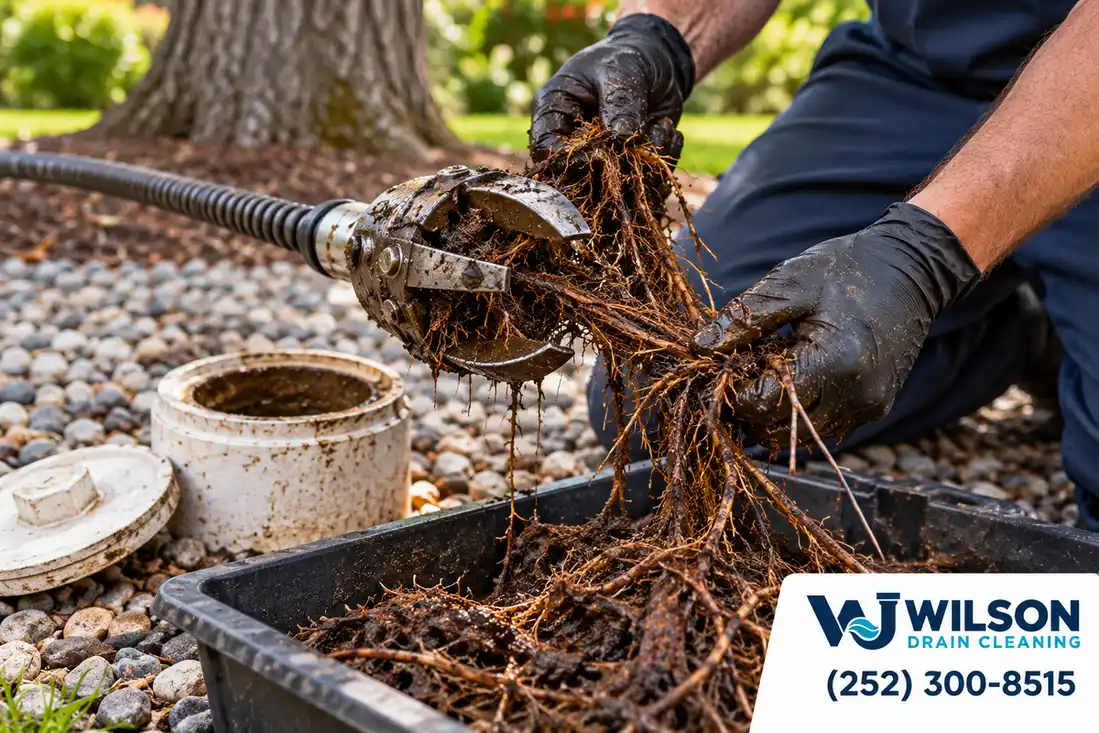
Work may include a cable machine with a root-cutting head, followed by water jetting when the pipe can safely take the pressure. The first pass cuts dense growth. Hydro jetting can wash away fine roots and debris left on the wall.
A post-cleaning camera inspection checks the cleared section. The camera can reveal a loose clay joint, cracked cast iron, deformed Orangeburg pipe or another opening. Locating equipment can mark the finding from above ground.
The next step may be planned maintenance, a labeled root-control product or pipe repair. Cleaning restores the opening. It does not seal the defect.
Why Sewer Root Removal Matters in Wilson
Roots inside a sewer line point to a pipe opening, not an unusually aggressive tree. Finding that opening matters because roots can grow back after cutting.
Wilson has established neighborhoods around West Nash Street, Broad Street, Kenan Street and the older street grid near downtown. Mature shade trees and older laterals can share the same narrow yard. Clay tile has many joints. Cast iron can crack or corrode. Orangeburg can lose its shape.
NC State Extension explains that roots exploit cracks and gaps that already exist. The roots enlarge inside the moist pipe and catch paper, grease and waste. That buildup can turn a partial restriction into a sewage backup.
The City of Wilson identifies tree-root infiltration as a sewer problem and uses closed-circuit cameras to find leaky joints and breaks. A private lateral needs the same evidence-first approach.
How It Works Step by Step
The process starts with the blockage and ends with a clear view of the entry point.
1. Confirm the line affected. Several fixtures backing up together usually point to the main building sewer. One slow fixture often has a smaller branch clog.
2. Inspect the accessible line. A camera can show the front edge of the root mass, pipe material and approximate distance. Heavy standing water may limit the first view.
3. Cut the dense roots. A cable carries a root saw or cutter through the restriction. Tool size and pressure must suit the pipe. Fragile material needs a controlled approach.
4. Wash out fine roots when suitable. Water jetting can remove loose fibers and waste that a cutter leaves behind. Jetting is not appropriate for every damaged line.
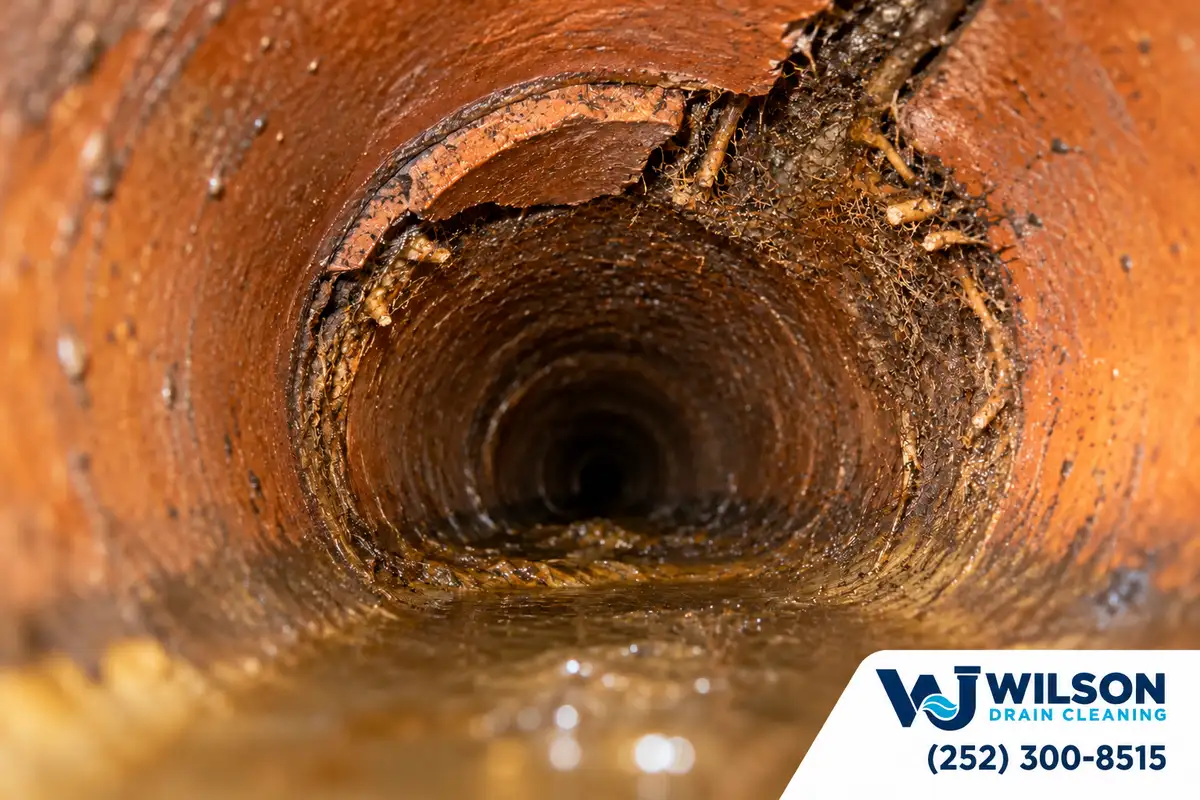
5. Run the camera again. The final pass checks how much root material remains and reveals the joint or crack. A locator can mark the defect in the yard.
6. Discuss maintenance or repair. The footage supports the choice between scheduled clearing, root treatment or repair.
Different root patterns call for different tools. The camera view helps separate light intrusion from structural failure.
Before and After Examples
Clogs and Problems We Handle
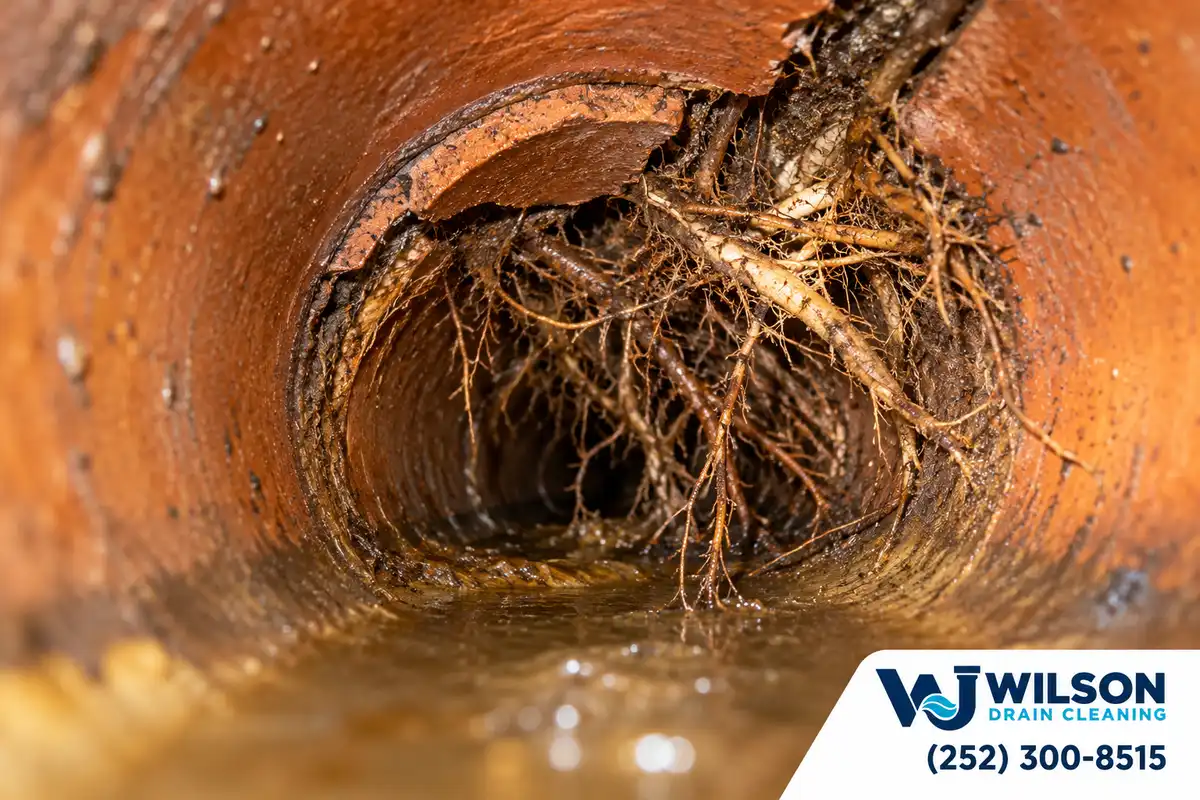
Fine Roots at Pipe Joints
Hair-like roots often enter around a clay hub or loose connection. They catch paper and slow the line before forming a dense mat.
Root Balls Blocking the Pipe
A thick root mass can stop nearly all flow. Opening the center may relieve the backup, but remaining roots can catch waste again.
Roots Through Cracks
Roots can enter a cracked clay or cast iron section. Cleaning exposes the damage. A repair may be more reliable than repeated cutting when the wall has failed.
Roots Near the Sewer Tap
Growth can appear close to the connection with the public main. Location matters because responsibility may change near the property-line cleanout.
Recurring Annual Blockages
A line that needs frequent cutting may have several open joints, a large defect or roots left behind. Camera footage can show whether the problem is stable or getting worse.
How Much Does Sewer Root Removal Cost in Wilson?
Cost depends on access, root density, pipe condition and the method needed. A visible, open cleanout usually costs less to work from than a line reached by removing a toilet.
For early planning, published 2026 market guidance places routine mechanical root cutting around $200 to $600. Heavy root removal with jetting can cost more. Camera work may be included or billed separately. These are broad planning figures, not a Wilson quote.
Will the Roots Come Back?
Price can change with:
- Cleanout access and pipe length
- Light joint roots or a dense root ball
- Clay, cast iron, Orangeburg or PVC
- Cable cutting alone or added jetting
- Camera recording and above-ground locating
- Repair work after the line is cleared
Protecting Your Home, Pipes and Yard
Many affected lines need periodic cleaning until the defect is repaired. A one-year or two-year interval is sometimes used for planning, but regrowth is not predictable. Soil moisture, opening size and roots left behind all matter. Camera records give a better baseline than a guess.
A root-control product may slow regrowth in some sanitary sewer lines. Use only a product labeled for the exact application and follow every direction. Do not put a sewer root product into a storm drain. Local rules, a nearby well and garden conditions also need consideration.
Related Services and Where We Offer This
Sewer line repair addresses the entry point. Depending on the pipe, that may mean replacing one section or discussing a larger repair. Do not remove a healthy tree before the camera shows where the roots enter.
FAQs
Should I Cut Down the Tree
Usually not as the first step. Camera footage may show one damaged joint or short pipe section that can be repaired. Fixing the pipe can stop the entry point without removing a mature tree.
Real job evidence should show the root mass, the cleared pipe and the damaged joint. A footage counter and locator reading help connect the camera view to a place in the yard.
After root removal, ask what the inspection shows about the entry point and whether further assessment or repair is recommended.
Accurate locating can prevent unnecessary digging by marking the damaged joint or pipe section.
Cutters must fit the pipe. An oversized head or forced cable can harm a fragile line. Jet pressure also needs to match the material and condition. Where work enters through the house, controlled equipment handling and floor protection help contain residue.
Root-control chemicals require care. Read and follow the product label. Keep products out of storm drains. Do not use them near a well, garden or sensitive planting unless the label allows that use and the site conditions have been checked.
Root removal is one part of a sewer plan. Cleaning restores flow. Camera work documents the defect. Repair closes the opening.
Service is centered in Wilson, including the West Nash and Broad-Kenan area. Nearby scheduling is covered through the local pages for Nashville and Elm City.
How Do Tree Roots Get Into Sewer Pipes
Roots grow toward moisture and enter through cracks, loose joints or other openings that already leak. Older clay and cast iron lines often have vulnerable joints or damaged sections. The roots expand inside and trap waste.
How Often Do Roots Need to Be Cleared
Some lines need clearing every one to two years until the entry point is repaired. The right interval depends on regrowth seen on camera, not a fixed promise. Faster recurrence calls for another inspection and a repair discussion.
Can Roots Be Removed Without Digging
Usually, yes. A cable cutter or water jet can work through a cleanout and restore flow without excavation. Digging becomes relevant when the pipe is collapsed, badly broken or ready for a permanent repair.
Get a Free Quote
Call (252) 300-8515 when several drains slow together or sewage rises at the lowest fixture. Stop using water until the line is checked. Details about the problem can be provided through the get a quote form.
Learn more about the technicians before scheduling.
Call (252) 300-8515 ↗